Agentic loops / Lucentive
Loop
A marketing team of AI agents, with a person at the desk
Loop is a private marketing system I designed for Lucentive’s own products. Give it a brief and AI agents plan a campaign, write the posts and draw every slide, then a person reviews the finished pieces before anything goes out. Today it runs privately in test mode: the parts are built, and live posting waits for the first product and account to be cleared.
Product direction, concept & architecture: Hendril Lara. Implementation: Lucentive engineers.
- My part
- Idea, concept, architecture and project lead
- Status
- Private prototype, posting in test mode
- Stack
- TypeScript, Next.js, React
- Since
- 2026
What it is
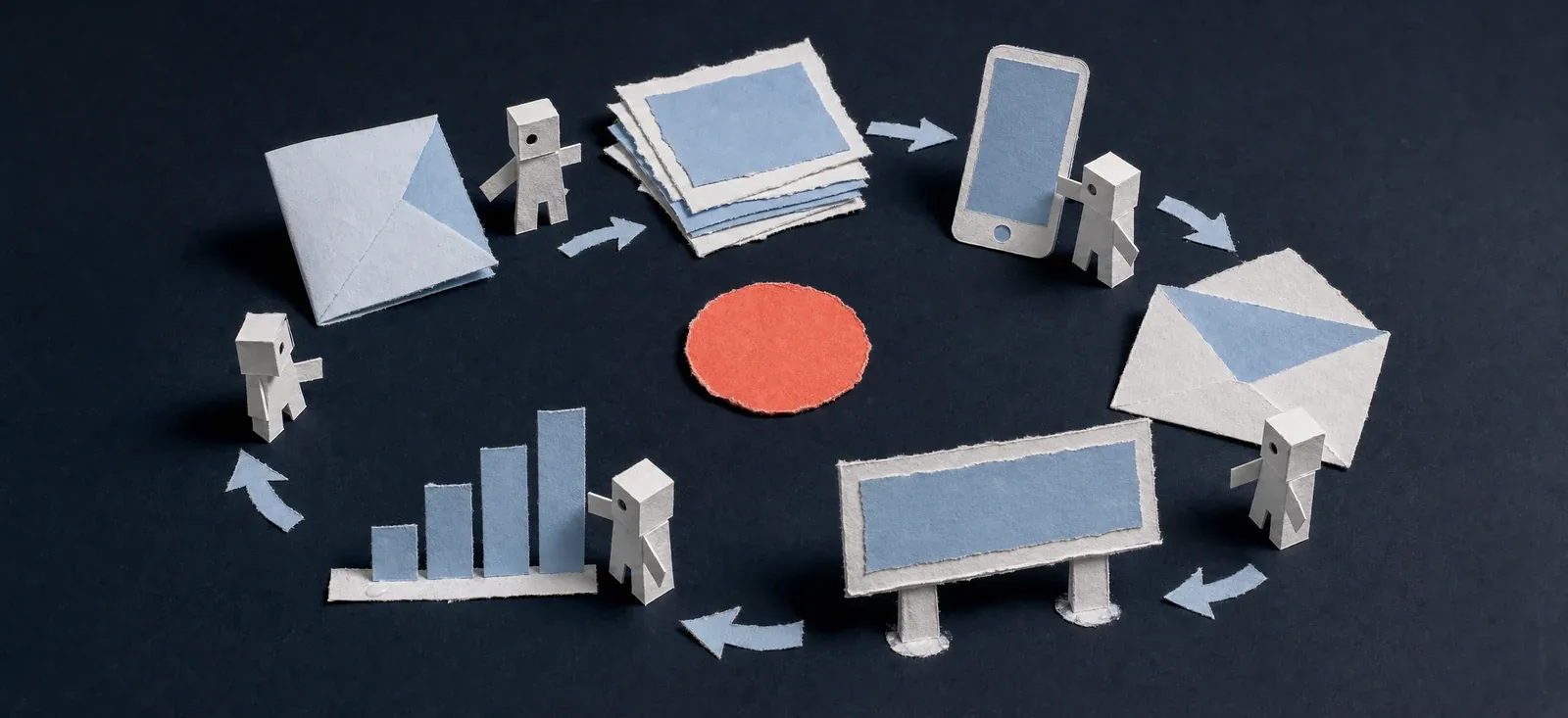
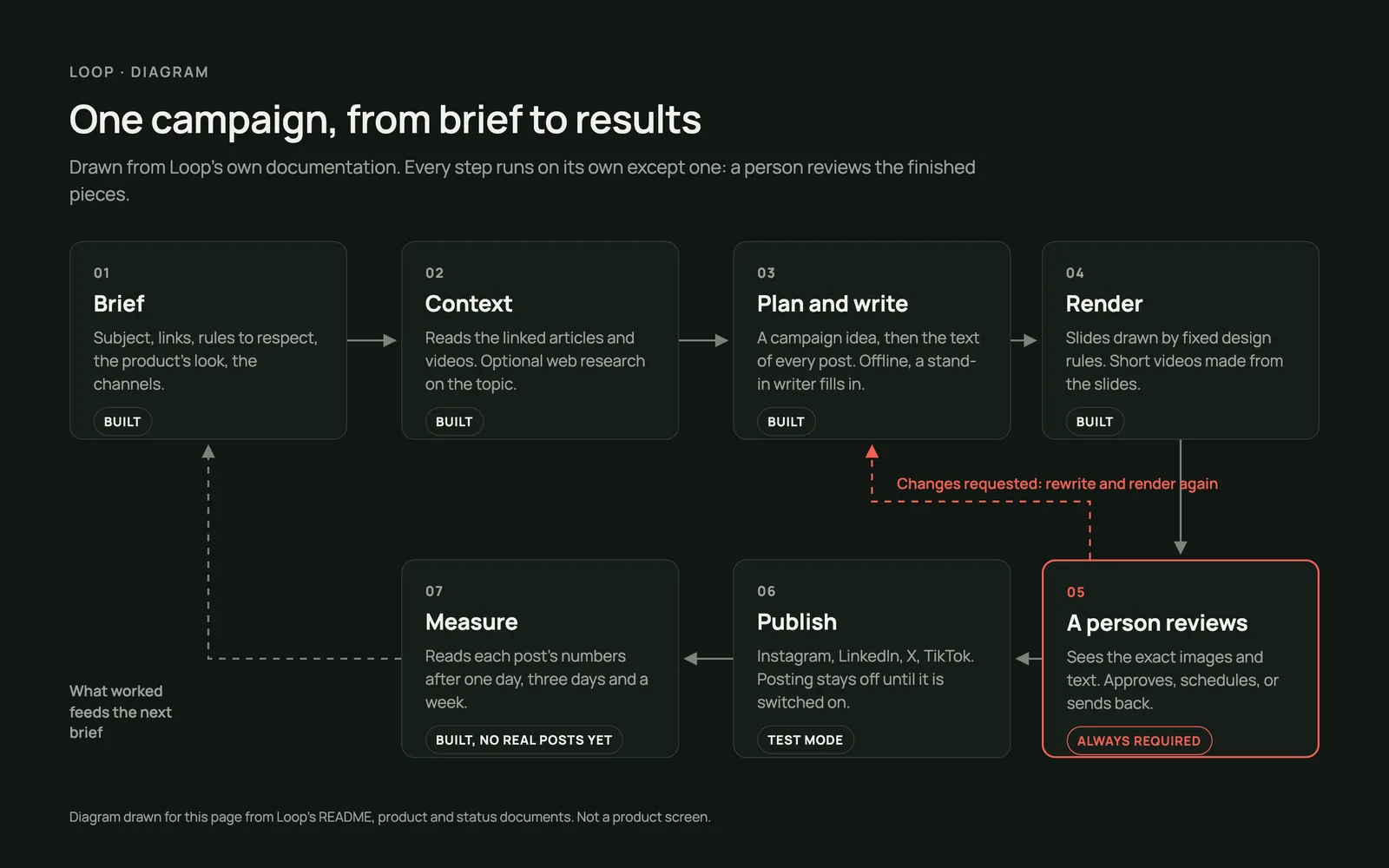
Loop turns a short brief into a ready-to-post campaign. The brief says what the campaign is about, who it is for, which links to read, which rules to respect and which channels to use. Agents read the sources, come up with a campaign idea, write the text of every post for every channel, and render the slides and short videos.
Then everything stops at one desk. A person looks at the exact images and captions that would go out and approves them, schedules them or sends them back with notes. After publishing, Loop is built to read each post’s numbers at set intervals and hand them to the next campaign’s writer.
Who it is for, and my part
Lucentive keeps starting products, and each one needs an audience. A small team cannot run a newsroom for every product, and handing the job to an unsupervised bot invites false claims and off-brand posts. I wanted the production work automated and the judgment kept human.
I came up with Loop and defined how it works: the order of the steps, what each product must supply, where the person sits and what stays off by default. I led the project, and Lucentive engineers built it with me.
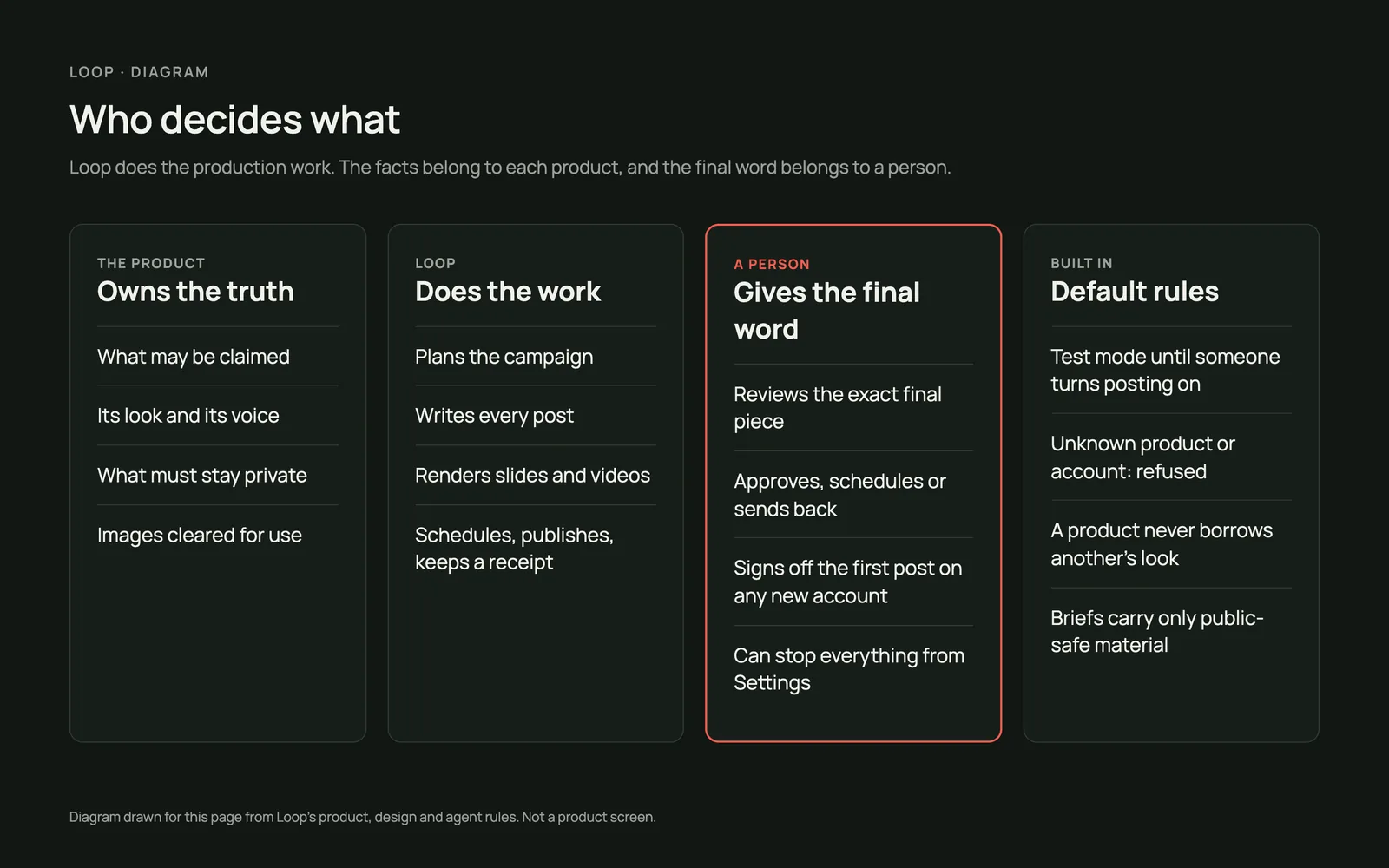
- Each product supplies its own facts, look and limits, and Loop is meant to work only from them.
- The design is fixed in code, so a model cannot drift off-brand.
- Nothing posts without a person, and test mode is the default.
- Other systems can send briefs too: Icarus, our app factory, can send one when an app is ready.
From brief to finished pieces
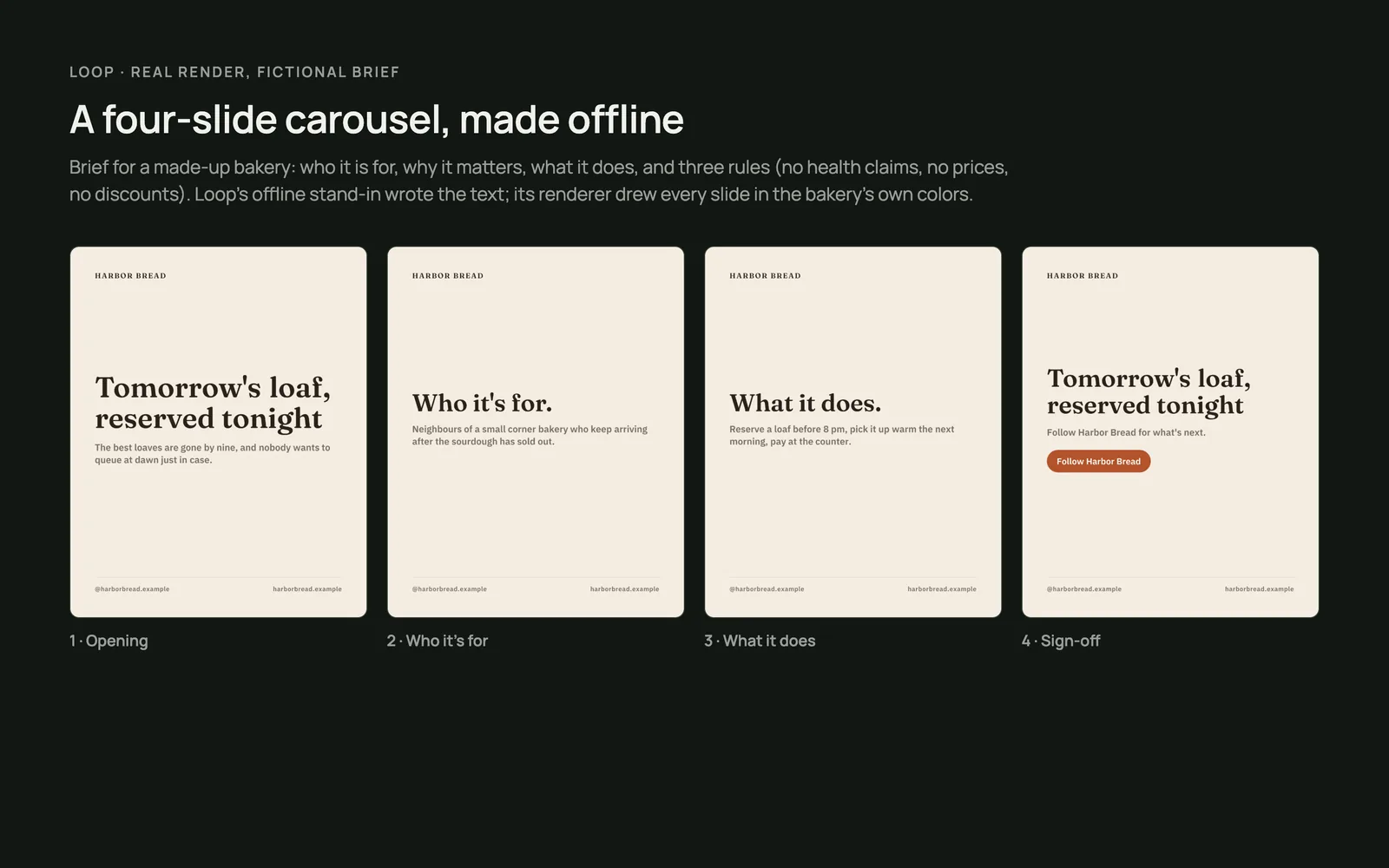
The writing step uses a cloud AI model when one is configured. Without it, an offline stand-in writes plain text straight from the brief, so the whole flow can be tried without spending anything. The carousel shown here came from that stand-in: a brief for a made-up bakery became four slides, a story and a caption.
A brief can also point to articles or videos. Loop reads them, strips them down to the text and passes them to the writer as background, and an optional web search adds current context. Words the brief asks to avoid are rewritten out of the copy.
The look lives in code, not in the model
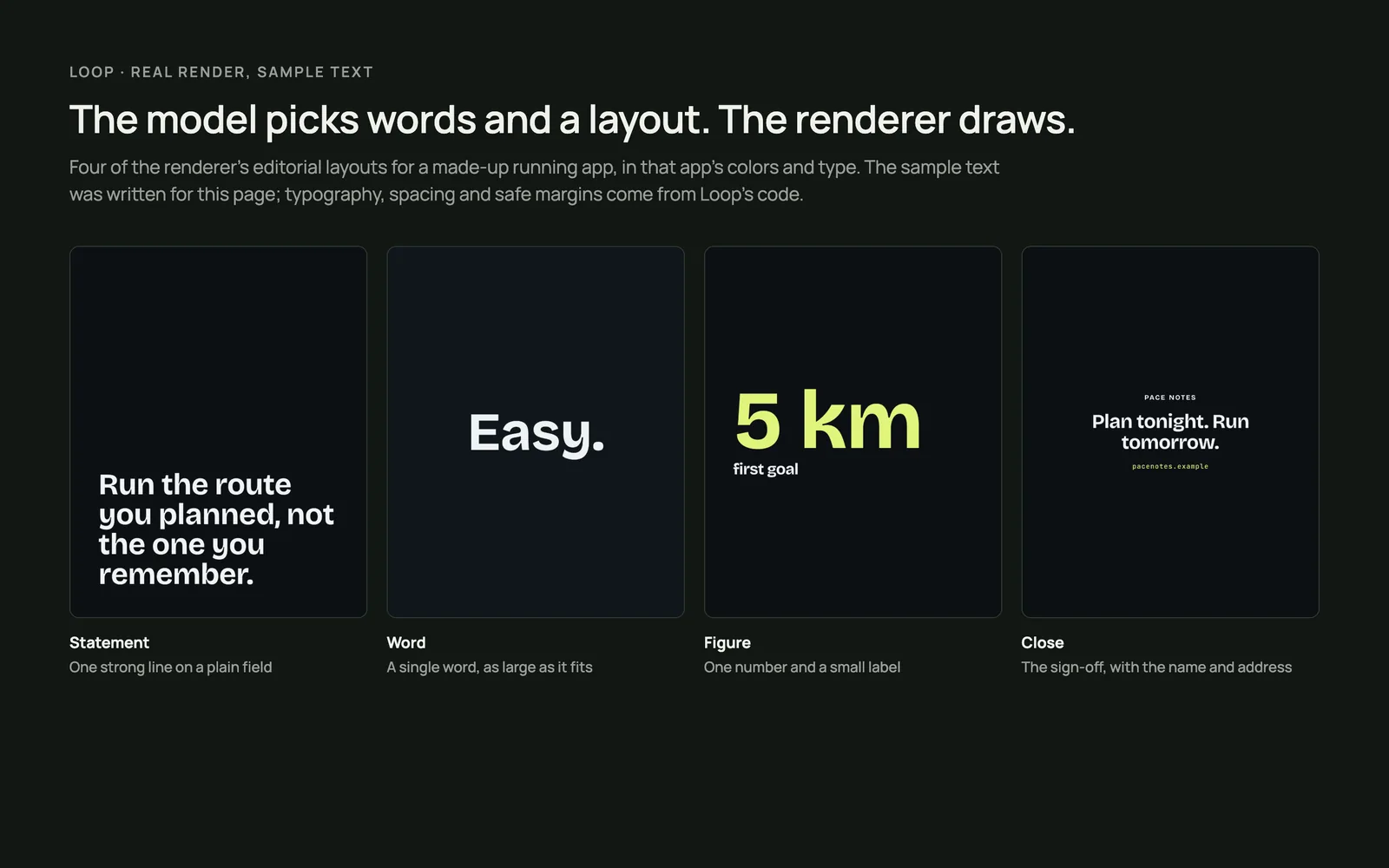
Image models cannot promise an exact color, a typeface or readable text on a slide. So in Loop the model only chooses the words and one of a fixed set of layouts. A renderer written in code draws every slide, and type, spacing, margins and colors come out the same on every piece, every time.
Each product can bring its own palette, type pairing and name. A product with no approved look is refused instead of being dressed in someone else’s. Generated background images are optional and always sit inside the fixed frame.
Nothing goes out without a person
The review page shows the exact files that would be posted, not a summary of a plan. The reviewer approves, picks a time, or asks for changes, which sends the campaign back to be rewritten and drawn again. Scheduled posts wait in a queue; a failed post is retried a few times, and one with an unclear result is set aside for a person to check.
Posting stays off until someone deliberately turns it on. The first post on any new account always needs a person, and a stop switch in Settings halts everything. Loop’s rules keep users’ private data out: a brief may carry only material that is safe to make public.
Where it stands
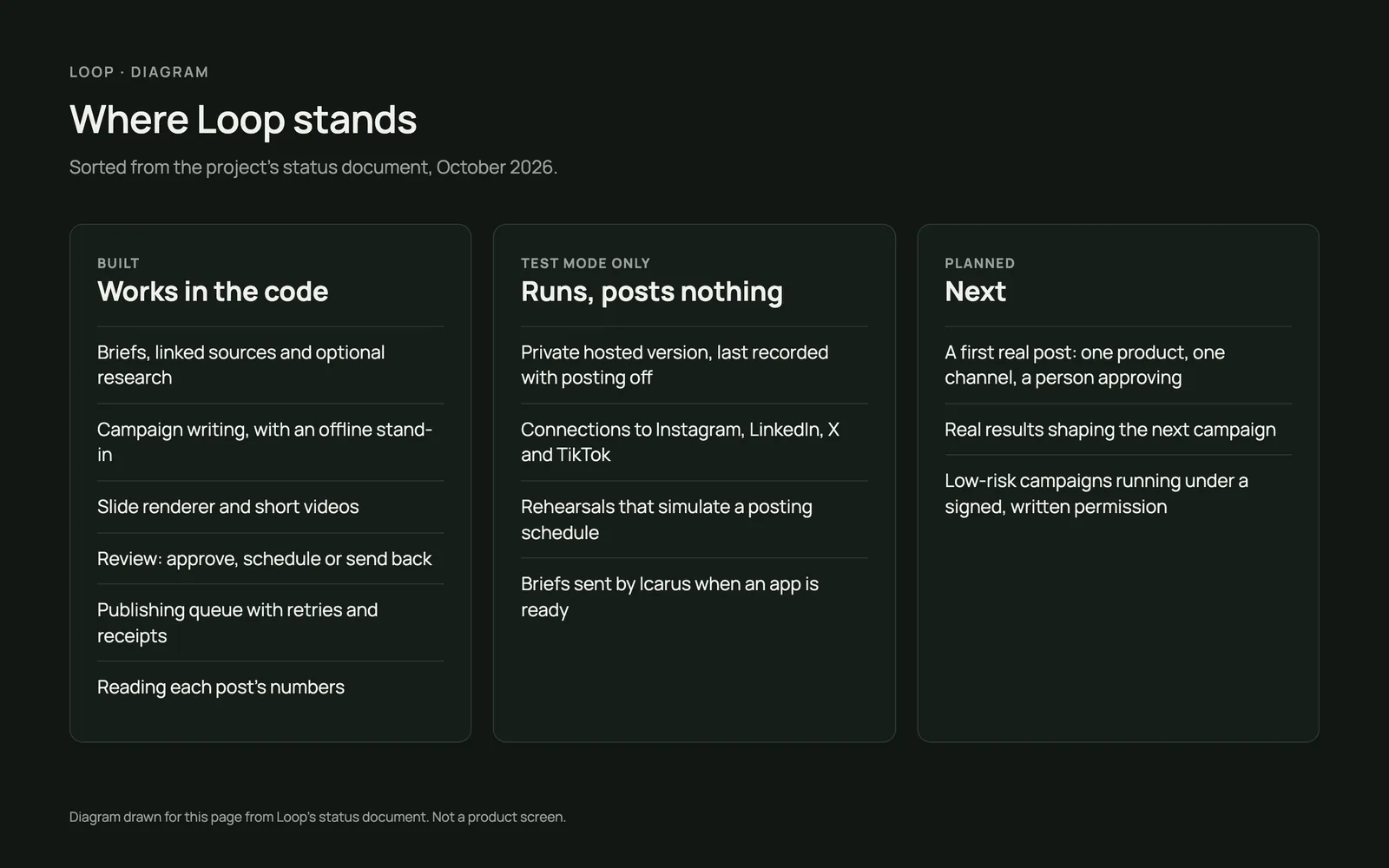
Loop is a private prototype. Everything described above is built and tested in code, and a private hosted version was last recorded running with posting switched off. Connections to Instagram, LinkedIn, X and TikTok exist, but no account has been cleared for live posting through them yet, and Icarus has sent it briefs only in test mode.
Next is the first real post: one product, one channel, approved by a person. After that, real results can start shaping the next campaign. Later, low-risk campaigns could run on their own under a signed, written permission. That part is planned, not built.
Next project